

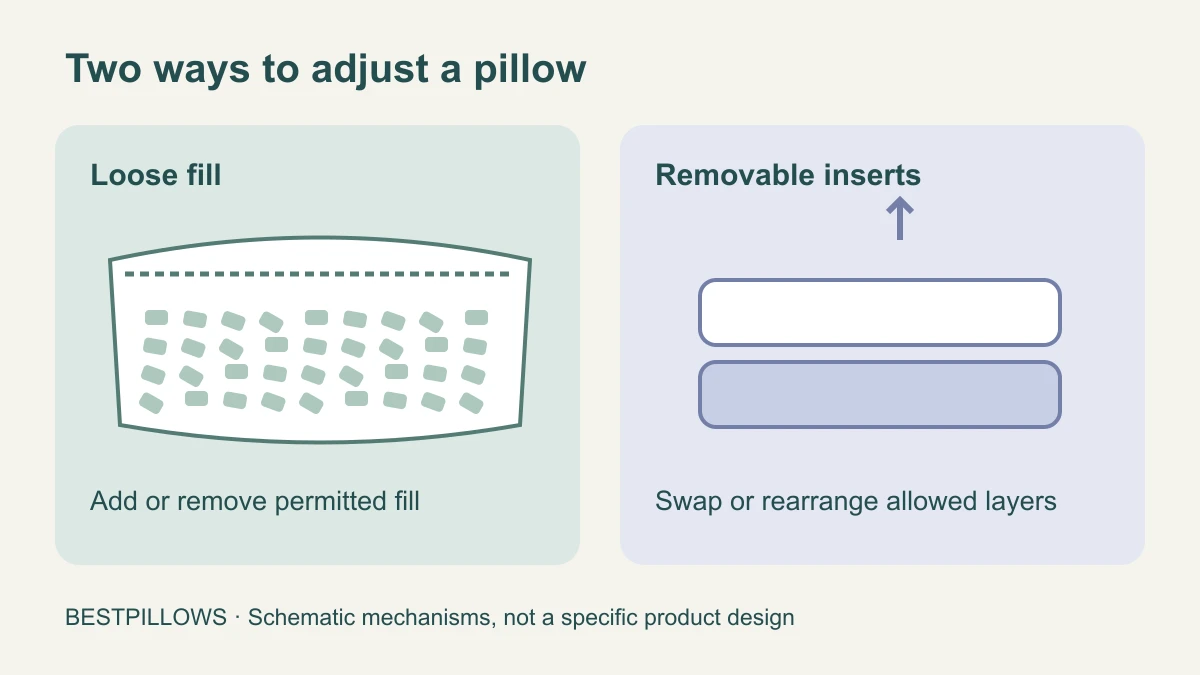
Start by finding out what your pillow lets you change. Some adjustable pillows let you add or remove loose fill; others use removable inserts that you can rearrange or exchange. Make one permitted change at a time, keep what you remove, and compare the result in the same bedding. There is no universal number of handfuls or inserts that fits everyone.
If the pillow has a fixed core, a zipper on its outer cover does not make that core adjustable. Follow the model’s setup instructions before opening an inner shell, removing a layer, or altering the filling.
Find the mechanism before changing the height
With a loose-fill pillow, the adjustment happens inside a shell. Coop’s adjustment instructions describe opening the outer and inner zippers, adding or removing fill, closing the pillow, and fluffing it to redistribute the contents. PureTree’s FAQ likewise describes removing fill through two zippered casings and keeping the extra in a bag.
An insert system offers different controls. The current LUXOME LAYR listing includes soft down-alternative, medium down-alternative/shredded-memory-foam, and firm solid-memory-foam inserts. Its suggested starting configuration uses two inserts with the desired feel on top. Swapping the upper insert changes the material you rest on; changing the combination also changes the overall setup. These are documented examples, not BestPillows product tests.
Do not treat an insert as a scoop of loose fill. Check which parts your version permits you to open or rearrange. Keep any supplied setup card: older packages and current online configurations may differ.
Travel pillows may instead adjust through a wrap, height dial or air valve. Our travel pillow fitting guide separates those controls from seat attachments. Some pillows use a refillable water pouch instead. Our water pillow setup guide explains how to separate water volume, trapped air, and the feel of the upper filling.
Height and surface feel are separate observations
If you are unsure whether the height is the issue, our guide to checking whether a pillow is too high or too low helps you describe the fit before changing the setup.
Loft describes height. Firmness describes how the pillow yields under pressure. A tall pillow can compress substantially, and a lower pillow can feel firm. Removing loose fill can change both height and resistance; switching an insert may change the surface feel as well as the total height.
Before making a change, describe what you actually notice: “too full at the center,” “surface feels too firm,” or “fill collects at one end.” This gives you a better comparison than “wrong pillow.” First redistribute loose fill as the maker directs. A lopsided distribution should not automatically lead to removing more material.
A sculpted pillow presents another issue. Turning it may change which edge you use without changing the amount of material. Our contour pillow orientation guide addresses that setup separately.
Run a small, reversible adjustment
- Record the starting setup. Note the inserts and their order, or take a photo of the loose-fill pillow after normal fluffing. Use the same case and protector for the comparison.
- Choose one change. For a loose-fill model, remove a small amount that you can easily put back, unless its instructions specify another starting adjustment. For a modular model, change one permitted insert or its position.
- Keep removed material identifiable. Put loose fill in a clean, closed bag labeled with the model. Keep spare inserts together. Do not mix fillings from different pillows.
- Close and reset the pillow. Close every opened casing fully and redistribute the fill as directed. Check that nothing is caught in the zipper.
- Compare in normal use. Note the height and feel separately. If the change helps, keep that configuration while you assess it; if it makes the setup worse, restore the starting version before trying a different change.
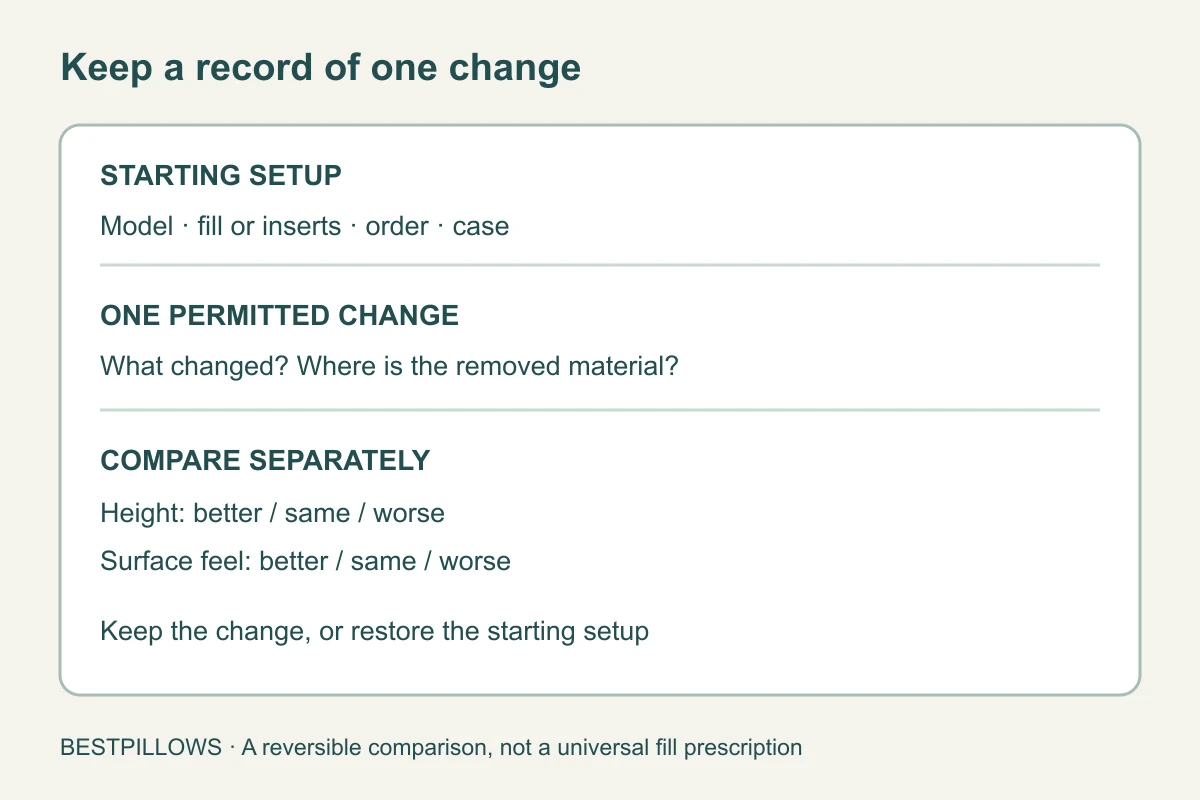
Changing the case, flipping the pillow, and removing fill together makes it hard to tell what helped. A restrictive case can also change the result. Use the pillowcase fit check before removing filling just to make a small case close.
Refill and cleaning need their own checks
Use replacement fill intended for your exact model. Coop’s refill range distinguishes several formulations; “foam” on a bag does not establish that it matches the pillow you own. Save the model information with any removed fill so you can reverse the adjustment later.
The ability to adjust a pillow does not establish washability. If your setup includes a solid foam insert, our solid memory foam cleaning guide explains how its care differs from washing the removable cover. LUXOME’s LAYR care directions require removing all filling before washing its covers. Other designs have different permissions. Our shredded memory foam care comparison explains why a washable cover and a washable inner pillow are different claims.
If the closure is damaged, the instructions are missing, or the pillow has no permitted adjustment mechanism, ask the manufacturer before modifying it. Cutting a fixed core or adding an unrelated filling is not part of this procedure.
Manufacturer documentation checked October 2, 2026. The adjustment record and diagrams are original BestPillows editorial aids. This guide does not prescribe a pillow for a medical condition or claim physical testing of the examples.