

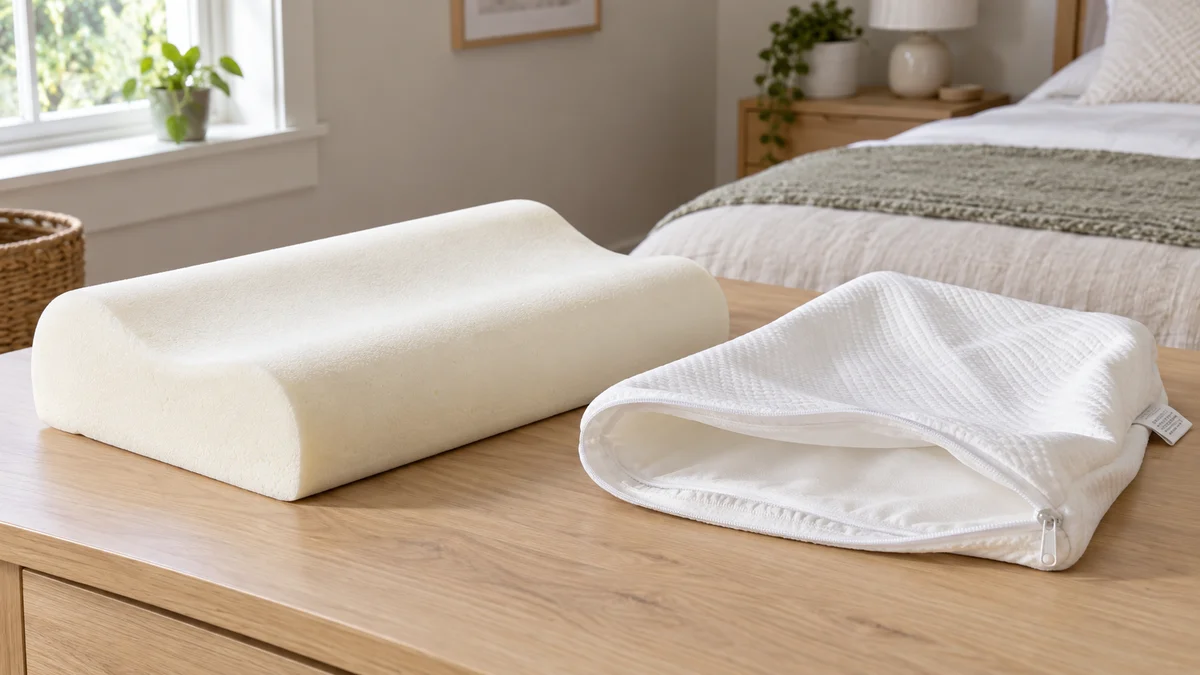
Do not put a solid memory foam pillow in the washer unless its manufacturer explicitly allows washing that exact insert. A removable, machine-washable cover has its own care instructions. Those directions do not give permission to wash the foam underneath.
Cleaning the surface is a separate question too. Some foam pillows allow spot cleaning; others restrict contact with liquids. Start by identifying the pillow and the part that needs attention before choosing water, detergent, or a drying method.
First, identify the foam inside
A solid foam pillow has a formed core rather than loose pieces of fill. It may be a conventional pillow shape, a contour with raised edges, or a design made with removable foam layers. A layered pillow still needs instructions for each insert; being able to remove a layer does not make it washable.
Check the model name on the label, packaging, or order record. Remove only the cover or inserts the manufacturer says are removable. Do not cut a liner open to inspect the foam.
If yours contains loose pieces, use our guide to washing shredded memory foam pillows. Some of those models permit washing the inner pillow, but that permission does not transfer to a solid core.
Match the care instruction to the right piece
Lay out the removable parts on a clean, dry surface. You may have a separate pillowcase, an optional protector, the pillow’s own zippered cover, and a foam core inside a liner. Keep any integral liner in place unless the instructions tell you to remove it.
| Component | What to check |
|---|---|
| Separate pillowcase or protector | Its textile care label, including temperature and drying restrictions. |
| Removable manufacturer cover | Whether it can be washed separately and how it must be dried. |
| Foam core and any integral liner | Whether cleaning is permitted at all, and whether that means spot cleaning or washing. |
A zipper answers how a component opens. It does not answer how to clean it. Likewise, a temperature printed on a cover label applies to that cover, rather than every piece inside it.
What manufacturers actually allow
These examples show why the word “memory foam” is not enough to choose a cleaning method. They compare published care information; BestPillows has not performed washing tests on these products.
- IKEA ROSENSKÄRM contains memory foam and polyurethane foam. Its care section prohibits washing and tumble drying the pillow, while allowing separate laundering of its removable cover.
- Brookstone Classic Comfort Memory Foam Pillow lists a machine-washable cover and restricts the memory foam to spot cleaning. Its product page does not provide a detailed spot-cleaning recipe.
- Tempur-Pedic’s U.S. cleaning FAQ says not to wash or submerge the insert unless its product instructions specifically permit it. The same FAQ gives separate washing directions for removable covers.
Read the label for your own version. If the label and website disagree, contact the manufacturer with the model name and a photo of both component labels before cleaning the foam. Even a product page can contain conflicting details: the ROSENSKÄRM page reviewed for this guide gives different cover temperatures in its specific care section and its general ergonomic-pillow advice. That is a reason to confirm the correct instruction for your item.
When only the cover needs washing
- Remove the cover as directed. Keep the foam and any nonremovable liner away from the laundry area.
- Use the cover’s own wash instructions. Check its permitted cycle, detergent, temperature, and any restrictions on bleach or other treatments.
- Follow its drying instruction separately. A washable cover may require air drying or allow a particular dryer setting.
- Reassemble only when the parts are dry. Settle the cover around the core without forcing the zipper or pulling the foam into a different shape.
For example, Tempur-Pedic’s general FAQ specifies cold water, mild detergent, and hanging removable covers to air dry. That is a documented instruction for the covers covered by that guidance, rather than a universal routine for every foam pillow cover.
Can you spot-clean the foam?
Only when the instructions for your model permit it. “Spot-clean only” limits treatment to a small affected area; it does not mean you can soak the core in a sink or wash it by hand.
If the label gives that restriction without a procedure, ask the manufacturer what cleaner, application method, and drying process it approves. Brookstone’s listing, for instance, establishes the spot-cleaning restriction but leaves those details unanswered.
A “do not wash” instruction also does not automatically authorize applying a wet sponge. Check for separate guidance about liquids and surface cleaning. Avoid borrowing a vinegar, baking soda, peroxide, or steam treatment from a general household-cleaning recipe when your pillow’s instructions do not allow it.
What if the foam has already become wet?
Determine whether the liquid stayed on a removable textile layer or reached the foam. Separate only the pieces designed to come off, and keep a damp core out of its cover and off the bed while you establish what to do next.
For moisture that has reached the interior, contact the manufacturer with the model, type of spill, and any cleaning already attempted. If you accidentally put the insert in the washer, include the cycle, water temperature, and products used. Ask for a drying and assessment procedure for that construction.
Do not improvise by wringing the core or increasing heat beyond its permitted care. The instructions reviewed here do not establish a universal drying time or guarantee that a soaked insert can be restored. A changed shape, damaged liner, or persistent odor warrants follow-up rather than simply covering the pillow again.
Protect the core between cleanings
Keep the removable textile layers on their own care routine. If spills are a concern, look for a protector with an explicit waterproof claim for the exact model. A washable fabric cover alone does not establish a liquid barrier.
Our guide to choosing a pillow protector explains protection claims, closures, and fit. Check that the added layer closes comfortably around the assembled pillow and does not distort its shape. The protector has its own care label too.
Frequently asked questions
Can a solid memory foam pillow go in the dryer?
Use a dryer only if the exact insert’s instructions permit it. A low-heat setting allowed for the removable cover does not establish permission for the foam. IKEA’s ROSENSKÄRM instructions illustrate this distinction: the cover and pillow have different drying permissions.
What if the pillow has no care label?
Use the order record or packaging to identify it and request instructions from the manufacturer. Until the insert’s care is confirmed, clean only a separate case or removable cover with clear directions of its own.
Manufacturer information checked October 10, 2026. This guide is based on product documentation, not physical washing or drying tests. Models and instructions may change; confirm the guidance for your particular pillow and each component.