

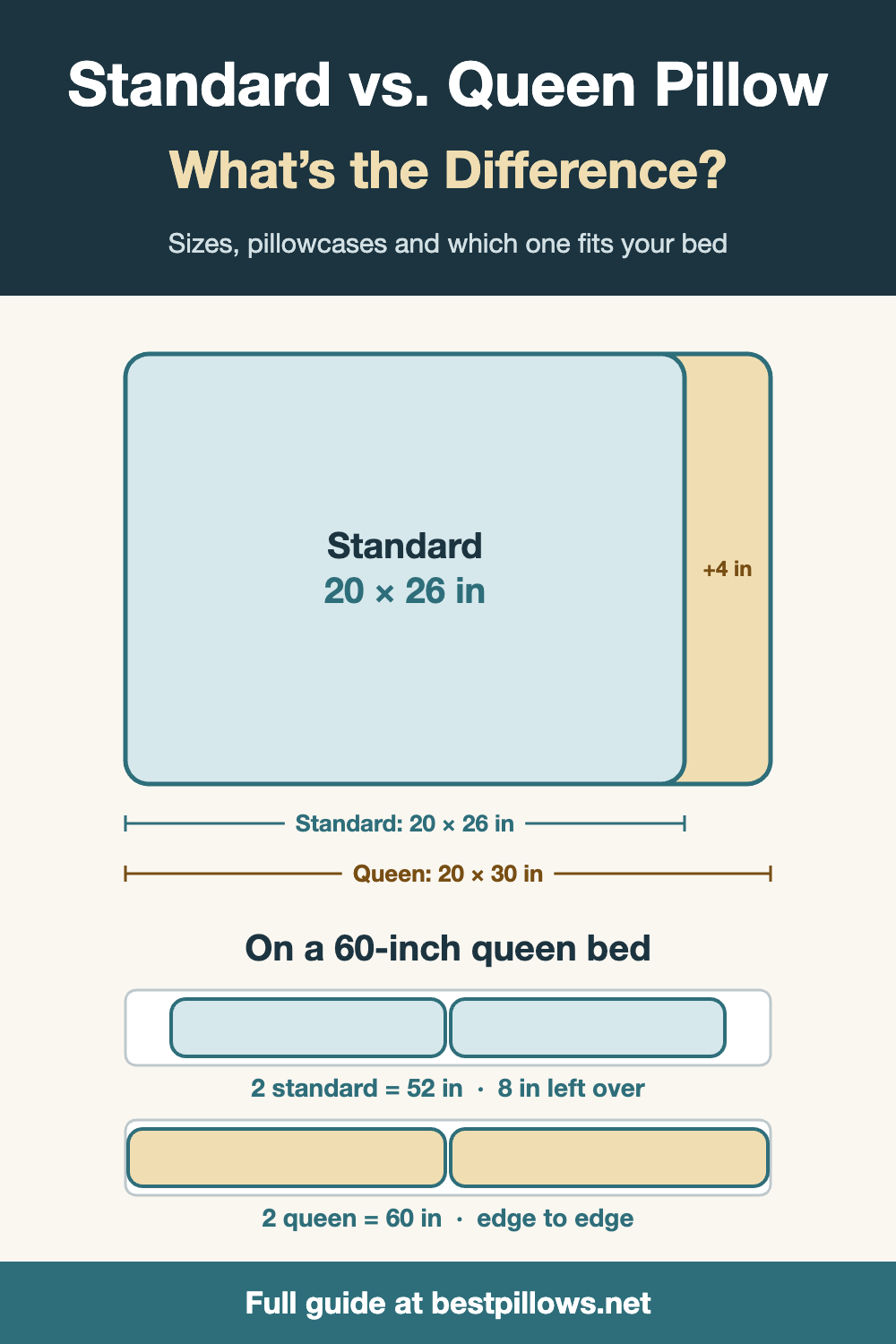
A standard pillow and a queen pillow are the same width. The queen is 4 inches longer. In common U.S. sizing, a standard pillow measures 20 × 26 inches and a queen measures 20 × 30 inches, so the choice comes down to how much side-to-side room you want and how the pillows line up across your mattress.
Those figures are conventions, not a regulated standard. Saatva’s pillow size chart and Boll & Branch’s dimension guide both list 20 × 26 for standard and 20 × 30 for queen, with a 20 × 28 “super standard” in between. Always confirm the size printed on the pillow you are actually buying.
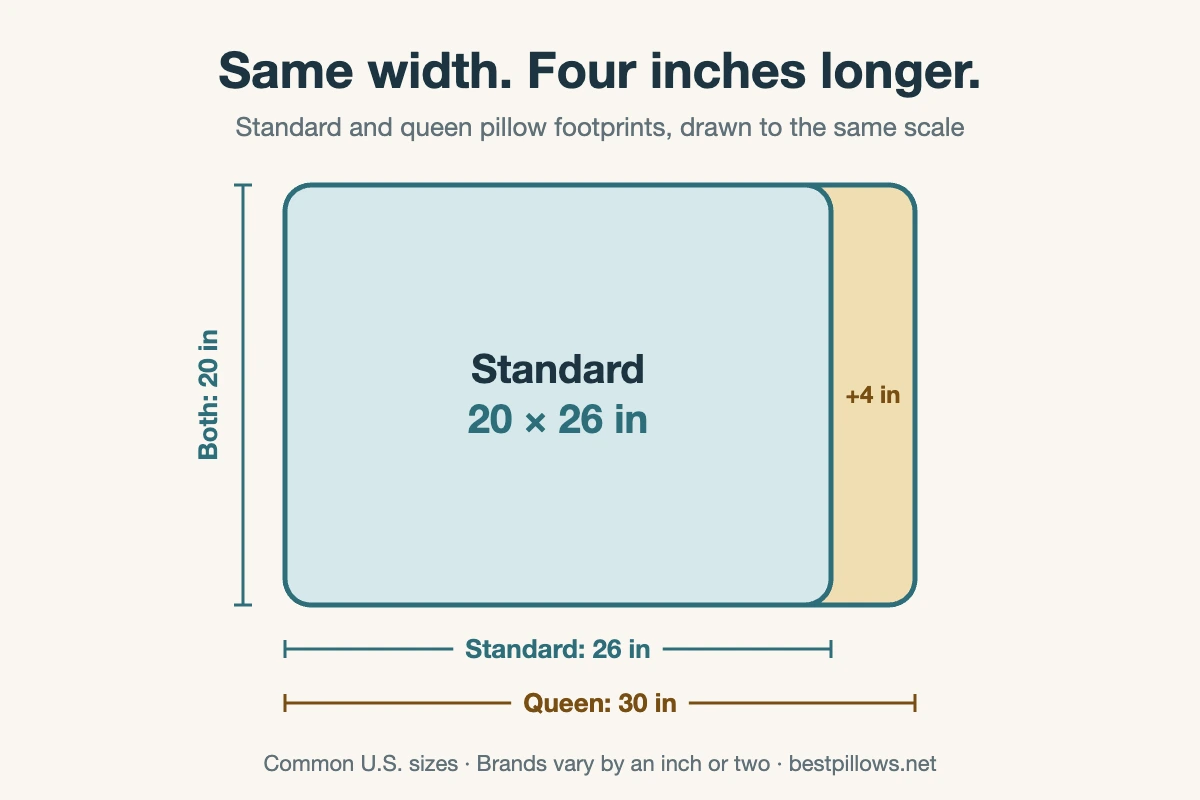
Standard vs. queen pillow at a glance
| Measure | Standard | Queen |
|---|---|---|
| Width (short side) | 20 in (51 cm) | 20 in (51 cm) |
| Length (long side) | 26 in (66 cm) | 30 in (76 cm) |
| Flat surface | 520 sq in | 600 sq in, about 15% more |
| Room each side of a centered head | 13 in | 15 in |
| Two side by side | 52 in | 60 in |
The surface and side-room rows are our own arithmetic from the nominal sizes: 20 × 26 = 520, 20 × 30 = 600, and half of each length. A filled pillow usually measures a little shorter than its flat label because the loft pulls the fabric in, so treat every number here as a starting point.
What those extra 4 inches mean for you
Width is what sits under your neck, and it is identical. Length is the direction you travel when you roll. With your head in the middle, a standard pillow gives you 13 inches before the edge on either side, and a queen gives you 15. If you turn over and stay on the pillow, the standard size already covers you. If you regularly wake with your head half off the end, the longer pillow addresses that specific problem.
Length does not change how high your head sits. That depends on loft and fill, which you can read about in our guide to checking whether a pillow is too high or too low. Two pillows of the same model can still feel different, because a maker may put more fill in the queen or stretch the same amount over a longer shell. Compare the listed fill weight for each size when the brand publishes it.
The bed-width math: which size lines up on your mattress
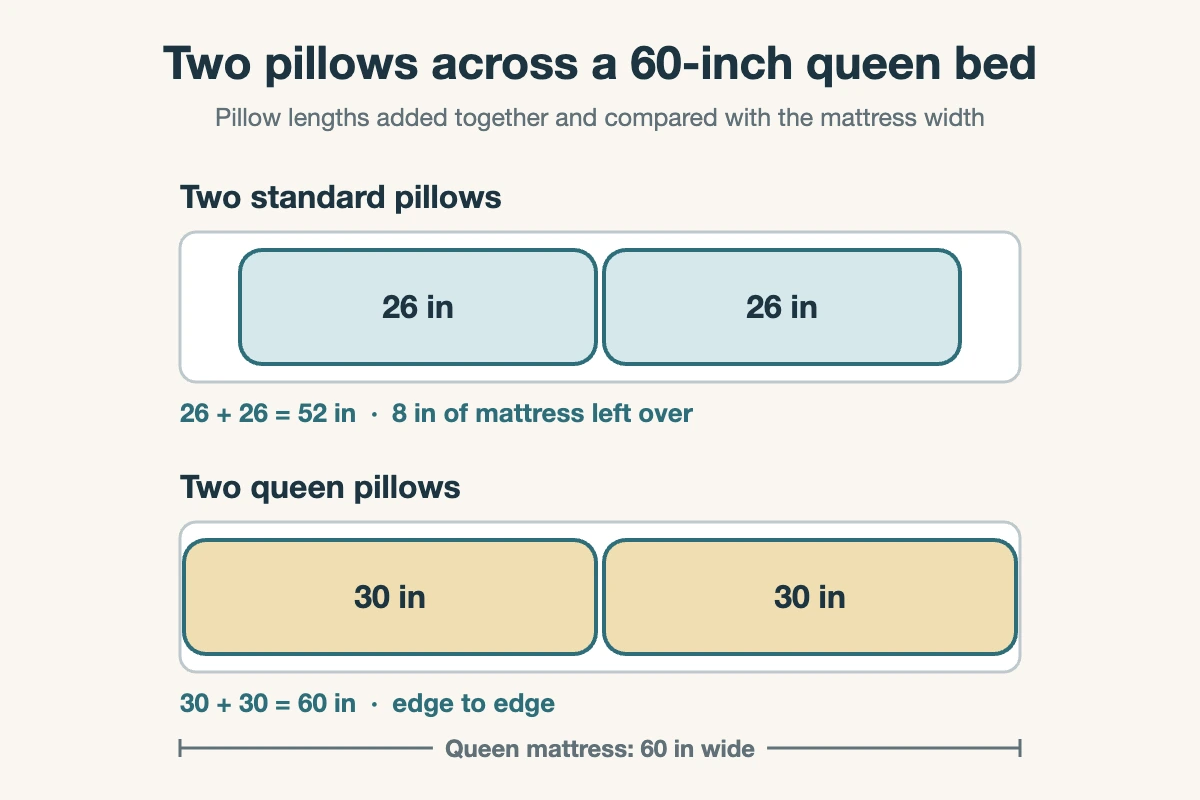
Pillow names sound like mattress names, but they do not map one to one. The practical check is simple addition: put the pillow lengths end to end and compare the total with the width of the mattress. U.S. mattresses are commonly 38 inches wide for a twin, 54 for a full, 60 for a queen, 76 for a king and 72 for a California king.
| Mattress | Standard pillows | Queen pillows |
|---|---|---|
| Twin, 38 in | One = 26 in. 12 in to spare. | One = 30 in. 8 in to spare. |
| Full, 54 in | Two = 52 in. 2 in to spare. | Two = 60 in. 6 in too long, about 3 in over each edge. |
| Queen, 60 in | Two = 52 in. 8 in to spare. | Two = 60 in. Edge to edge. |
| King, 76 in | Two = 52 in, 24 in to spare. Three = 78 in, 2 in too long. | Two = 60 in. 16 in to spare. |
| California king, 72 in | Two = 52 in, 20 in to spare. Three = 78 in, 6 in too long. | Two = 60 in. 12 in to spare. |
Three results in that table are worth acting on:
- On a full bed, standard is the closer fit. Two standard pillows come within 2 inches of the mattress width. Two queens overshoot it by 6.
- On a queen bed, both work, with a different look. Two queens meet in the middle and reach both edges. Two standards leave 8 inches, which some people prefer because the pillows do not press against each other.
- On a king, neither size fills the width in a pair. Three standard pillows come closest at 78 inches against 76, which is why you often see three across on a king. Two king pillows, at 20 × 36 inches each, total 72.
Soft pillows compress where they touch, so a total that is an inch or two over the mattress width still sits on the bed. A total that is far under simply leaves visible mattress.
Pillowcases: where the two sizes overlap
Many standard pillowcases are cut longer than a standard pillow, and that is why the two sizes often share a case. Boll & Branch states that a queen pillow can also fit in a standard pillowcase. The trade-off is tightness: Sleep Doctor notes that a standard case on a queen pillow may make it feel firmer and loftier, because the fill has less room.
The reverse pairing is looser. A standard pillow inside a queen case leaves about 4 inches of extra fabric at the open end, which you can fold under. It looks less tidy and does not affect support.
Case labels vary by brand, so two cases marked “standard” can leave different amounts of room. We compared real product specifications in our guide to whether a queen pillow fits in a standard pillowcase. If you add a pillow protector, size it to the pillow, since it adds a layer inside the case.
When “standard” and “queen” do not mean 26 and 30
Before you assume the 4-inch gap, check the brand’s own chart. Three patterns come up often:
- A brand’s standard may already be 28 inches. Helix says its standard size is 20 × 28 inches and that it does not make a queen pillow at all.
- Shaped and latex pillows follow their own sizes. Savvy Rest lists several of its queen pillows at 16 × 28 inches, narrower and shorter than the general 20 × 30.
- “Standard/queen” on a package is one size, not two. It usually means a single pillow or case intended to work for both. Read the inches, not the name.
If you already own the pillow and the label is gone, measure seam to seam along the long side with a soft tape, without flattening the fill. A reading near 26 is a standard, near 28 a super standard, and near 30 a queen.
Which one should you choose?
Choose standard if you sleep on a twin or full bed, you stay on the pillow when you turn, or you want the widest choice of cases and the easiest fit in a home washer when the care label allows machine washing.
Choose queen if you sleep on a queen bed and want two pillows to reach edge to edge, you move across the pillow at night, or you share a bed and want less gap between the two pillows.
Either works if you sleep alone on a queen or larger bed and do not run out of pillow. In that case decide on loft and fill first. An adjustable pillow lets you fine-tune height in either length.
For decorative layers in front of your sleeping pillows, the sizing rules change again. Our guide to choosing an insert for a Euro sham covers square covers and inserts.
Quick answers
Is a queen pillow wider than a standard pillow?
In common U.S. sizing, no. Both are 20 inches on the short side. The queen is 4 inches longer on the long side.
Can I use standard pillows on a queen bed?
Yes. Two standard pillows total 52 inches on a 60-inch mattress, so they fit with 8 inches to spare.
Do I need queen pillowcases for queen pillows?
Not always. Many standard cases are long enough, but a full queen pillow can feel tighter in one. A queen case gives the fill more room.
Manufacturer and retailer size guides reviewed November 13, 2026. Bed-width totals are our own calculations from nominal sizes; filled pillows and individual brands vary.