

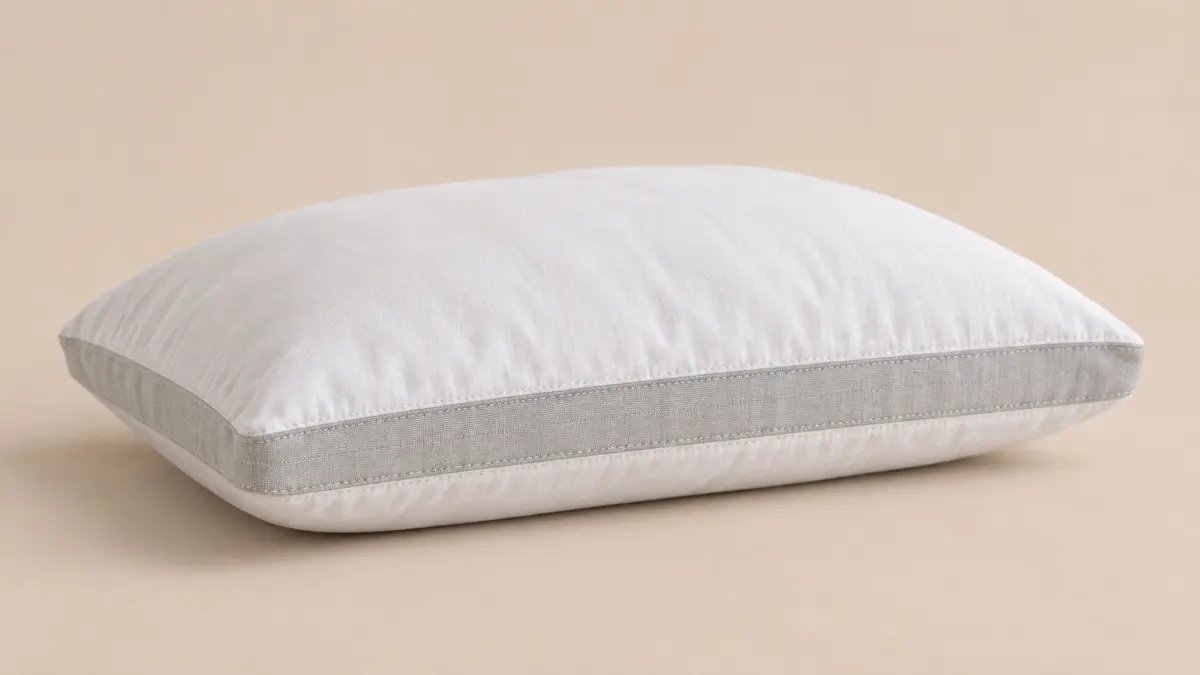
A gusseted pillow has a separate strip of fabric joining its upper and lower panels. Instead of meeting at one thin edge, the two faces are separated by a side wall. That changes the construction of the shell. It does not, by itself, tell you how firm the pillow is or how high your head will rest.
The useful question is not simply whether a pillow has a gusset. It is what the side panel surrounds, what the listed measurements describe, and whether the finished pillow works inside your case.
How to recognize a gusset
Look at a side view. A conventional knife-edge shell brings the top and bottom panels together at a perimeter seam. A gusseted shell has a band between them, with a seam along the band’s upper edge and another along its lower edge. Rounded corners do not change that distinction.
Piping is different: it is the narrow cord-like trim you may see along a seam. A pillow can have piping and a gusset at the same time. A contrasting stripe or a decorative seam, on its own, is not enough to identify a separate side wall.
For a concrete manufacturer example, GoKindly describes its Signature pillow’s gusset as a 4 cm side panel. That is a description of that product’s construction, not a standard dimension for every gusseted pillow.
Gusset width and sleeping height are different measurements
A listing that says “2-inch gusset” identifies the side panel. It does not establish a two-inch finished pillow height, and it certainly does not measure the support beneath your head after the fill yields. The upper and lower surfaces can curve beyond the panel, and the pillow’s behavior also depends on what is inside.
Coop’s size guide, for example, lists its Queen Crescent and Queen Cut-Out at 18 × 28 inches with a 2-inch gusset. Matching numbers do not make their outlines identical. Nor do those figures specify their height under a sleeper’s head.
Keep three separate notes when comparing products: length and width, gusset size, and any separately stated overall height. Leave a field blank if the maker does not supply it. Do not fill the gap by measuring a promotional photograph or adding the gusset to another dimension.
If the concern is the support you feel in bed, our guide to checking whether a pillow is too high or too low takes the comparison beyond the size label.
A manufacturing detail that explains confusing size charts
Even the shell’s length and width need context. In its publicly available August 2023 vendor manual, Appendix H, Cuddledown lists a Queen knife-edge shell at 20 × 30 inches. Its Queen gusset shell is listed separately at 19 × 30 inches with a 1.5-inch gusset. Both tables specify a ±3% tolerance.
Those are that document’s shell specifications, not measurements of every current Cuddledown retail pillow. The useful lesson is narrower: two shells can share a size name while their construction specifications differ. A one-inch difference in a table does not mean you should automatically buy a one-inch narrower pillowcase.
A current retail example makes the same need for careful reading visible. Parachute’s Down Alternative Side Sleeper listing separates its Standard dimensions, 16.5 × 22.5 inches, from a 3.5-inch gusset. Use the product’s fit guidance; do not turn those entries into a universal formula for calculating case size.
The side panel does not identify the filling
Gusseted describes a construction feature, not a material. The Parachute example has polyester filling arranged in chambers. The Company Store’s Comfort Cushion Memory Foam Gusseted Pillow uses memory-foam clusters and has a removable cover.
That distinction matters when two products both promise support. Ask what fills the pillow, whether it has separate chambers, and whether adjustment is actually permitted. A zipper may open only the washable cover; it does not automatically give permission to remove filling or alter an inner shell.
If the material choice is still undecided, our comparison of down and down-alternative pillows explains how to read composition and construction together. A gusset cannot settle that choice for you.
Check the pillowcase before judging the pillow
A case has to accommodate a three-dimensional object. Matching the two largest numbers on the labels is only a starting point. Settle the corners inside the case and look at the side panel: is it being pulled inward, or does the pillow retain its intended shape? An envelope end should stay covered, and a zipper should close without having to squeeze the pillow into place.
Before removing any permitted fill, resolve an obviously restrictive case. Otherwise, you may be adjusting the pillow to compensate for the cover. Our queen pillow and standard pillowcase guide explains how to check the main body and closure separately.
A gusset does not always require a special case, and a case advertised for a gusseted pillow is not automatically right for yours. Look for an explicit compatible size or model. If it is missing, ask the seller what pillow dimensions and depth the case is designed to accommodate.
Care follows the components, not the seam
The two retail examples have different instructions. Parachute allows cold machine washing of the named down-alternative model and low tumble drying. The Company Store specifies a cold wash and low tumble dry for the Comfort Cushion cover, while its memory foam is spot-clean only.
Neither instruction follows from the presence of a gusset. Check the label for your exact version and distinguish the outer cover from the filled pillow. Do not apply a washable cover’s instructions to the material inside it.
A short comparison card to use before buying
Copy these four prompts into your notes for each candidate. This is an editorial buying aid, not a product test or a scoring system.
| Record | Question to resolve |
|---|---|
| Shape and measurements | Which figures describe the shell, gusset, finished pillow or packaging? |
| Interior | What is the fill, how is it arranged, and can it be adjusted? |
| Case | Is compatibility stated, and can the closure work without compressing the pillow? |
| Care | Which instructions apply to the cover, and which apply to the filled component? |
Choose the complete pillow rather than treating the side panel as a guarantee of firmness, lasting loft or comfortable fit. If a listing cannot answer these questions, that missing information is a better reason to contact the manufacturer than the word “gusseted” is a reason to buy.
Manufacturer documentation checked November 2, 2026. The Cuddledown manufacturing example is explicitly dated August 2023. BestPillows has not physically tested these products; examples illustrate how to read specifications and are not a ranking.