

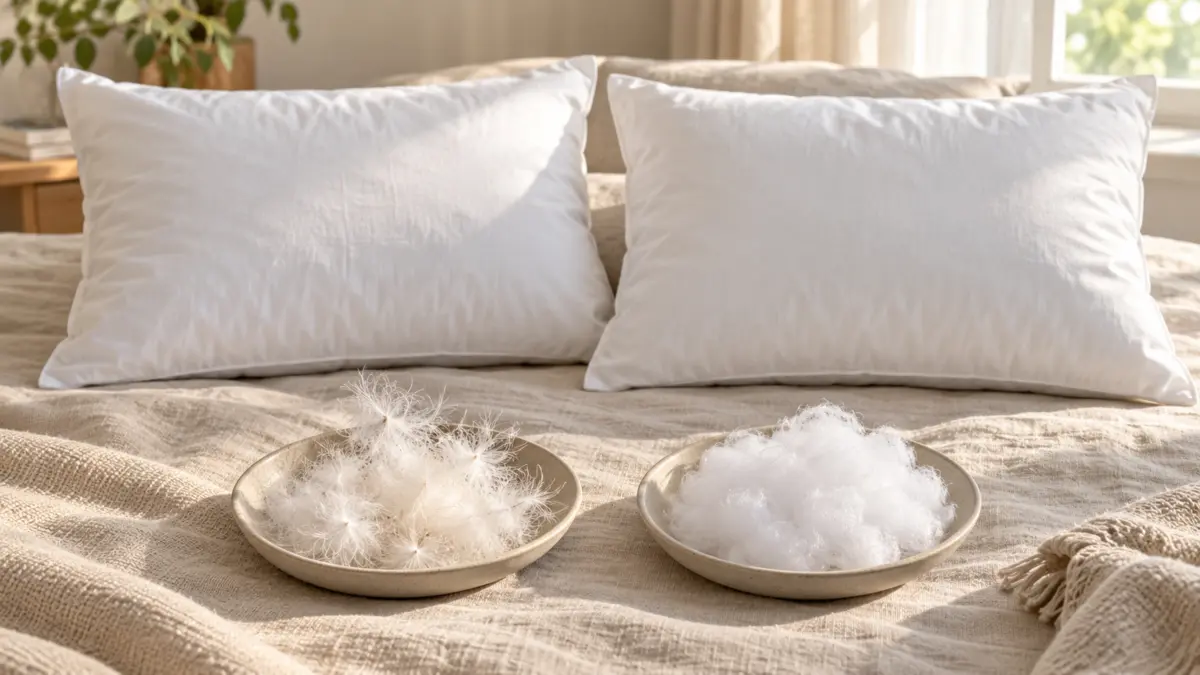
Down pillows contain the soft clusters found beneath a duck’s or goose’s outer feathers. Down alternative pillows use a substitute, commonly polyester fiber, intended to offer a similar fluffy feel. If avoiding animal-derived filling is your priority, look for a fully synthetic fill. If you want down, check the actual composition and the version you are buying.
After that, the choice gets more personal. You might enjoy a pillow you can reshape, need a different height, or want something you can realistically wash and dry. Those details deserve more attention than a broad promise that one filling is “better.” Here is how to compare two pillows without getting lost in the labels.
Read the filling, then the cover
A product called a down pillow can contain more than down clusters. For example, Parachute’s Down Pillow lists 85% down clusters and 15% down and feather fibers. Its Down Alternative Pillow lists 100% recycled polyester filling. Both have cotton sateen shells.
That separation matters. “Cotton” may describe the fabric against the pillowcase, while “polyester” describes what is inside. Read each component rather than treating the first material named on the page as the whole pillow.
Also check whether a natural-fill pillow has separate inner and outer chambers. Our guide to down, feathers, and chambered construction explains how to read those details. A soft outer layer and a different core are useful information when you are trying to understand what you will feel.
Compare firmness within the right size and model
Start with the exact size you need, then compare the available firmness options. A larger pillow and a smaller one with different amounts of filling are poor starting points for judging the effect of the material alone.
Parachute provides a useful example. Its size guides publish the following figures for two Standard pillows with the same 20 × 26-inch dimensions:
| Model | Soft | Medium | Firm |
|---|---|---|---|
| Down | 12 oz | 16 oz | 23 oz |
| Down Alternative | 22 oz | 27 oz | 35 oz |
The tables do not explicitly identify these as net filling weights, so ask the maker before using them that way. They also do not establish that the two Medium pillows feel identical. Treat ounces as one specification, not a firmness score you can transfer between fillings.
Keep three terms separate: fill weight is the amount of filling; loft is height; firmness describes resistance as you press or rest on the pillow. When a listing gives a weight, check whether it means filling alone or the complete item.
What fill power can tell you
Fill power describes the volume a measured amount of filling occupies under specified test conditions. IDFL’s test explanation describes a conditioned sample measured under a prescribed load. It measures the material in a test apparatus, rather than a finished pillow beneath your head.
A higher number therefore cannot, by itself, tell you whether the pillow will hold your preferred sleeping height. You still need to consider the amount of filling, how it is distributed, and the finished construction. Think of fill power as useful background when comparing down specifications; leave the final comfort decision to the actual pillow.
Look more closely at “gel” and other fiber names
Some down alternative names sound as though they describe a cooling system. Take DOWNLITE’s MicroLoft Gel pillow: the manufacturer describes its gel filling as siliconized polyester fiber with a dense, squeezable feel. In that example, the wording describes the fiber and its handling. It does not establish that the pillow contains a cooling gel layer or stays cooler overnight.
Even “polyester” leaves room for different designs. DOWNLITE’s filling guide describes fibers formed into small clusters as well as polyester opened into a continuous sheet and rolled. When comparing synthetic pillows, look for that extra detail about the structure. A shared fiber name is only the beginning of the comparison.
Check what you can adjust
If you often wish your pillow contained a little less filling, look for an adjustment system before choosing a material. DOWNLITE offers both a 3-in-1 down pillow and a down alternative version with a removable inner pillow. These adjust through components, rather than handfuls of loose filling.
Follow the instructions for the exact model. A zipper on another pillow may open only its cover. During any permitted home trial, use your usual mattress and a correctly fitting pillowcase, and check the positions you normally sleep in. Our guide to whether your pillow is too high or too low can help you separate a height problem from a preference about cushioning.
Read the washing directions before you buy
“Machine washable” sounds convenient until you discover that the instructions call for equipment you do not have. Care requirements vary within the synthetic category, too.
| Example | What the maker specifies | What to check before ordering |
|---|---|---|
| Parachute Down Alternative | Allows dry cleaning or cold machine washing; low tumble drying. | Can you complete the permitted drying process? |
| The Company Store Premium Best Down Alternative | Prohibits dry cleaning; recommends a commercial front-loading machine for best laundering. | Does your intended cleaning method match these directions? |
| Brooklinen Down and Down Alternative | Its pillow care section specifies commercial washers and dryers only. | Do you have access to that equipment? |
These are buying considerations, not complete washing instructions. Keep the label that comes with your pillow and follow its full directions. For a washable natural-fill model, our guide to drying a down pillow when the filling still clumps explains the checks that a dry-feeling surface can miss.
Make the choice personal: keep, change, must have
Before opening another product page, write three short lines about the pillow you already use. This helps turn a vague material preference into something you can compare:
- Keep: something you enjoy, such as being able to gather the pillow into a comfortable shape.
- Change: one specific frustration, such as “it feels too low after I settle onto it.”
- Must have: a practical requirement, such as entirely synthetic filling or care you can manage with the equipment available to you.
Suppose you like the cushioning but keep folding your pillow to raise it. Your next comparison should focus on height, resistance, and adjustment options. Switching materials without checking those features leaves the original problem unresolved.
Now put two candidates beside your three lines. Mark each requirement as confirmed, unsuitable, or not stated. A missing detail is a question for the seller, not an automatic failure. If a pillow requires a cleaning arrangement you will never use, however, that is a concrete reason to reconsider it.
For down, start with the composition and construction you want. For down alternative, start with a clearly identified synthetic filling and its design. In either case, read the return conditions for an opened or used pillow before relying on a home trial. Choose the model that addresses your actual frustration while keeping the qualities you already enjoy.
Product documentation checked October 22, 2026. These U.S. examples illustrate published specifications and care differences. BestPillows has not physically tested the products.