

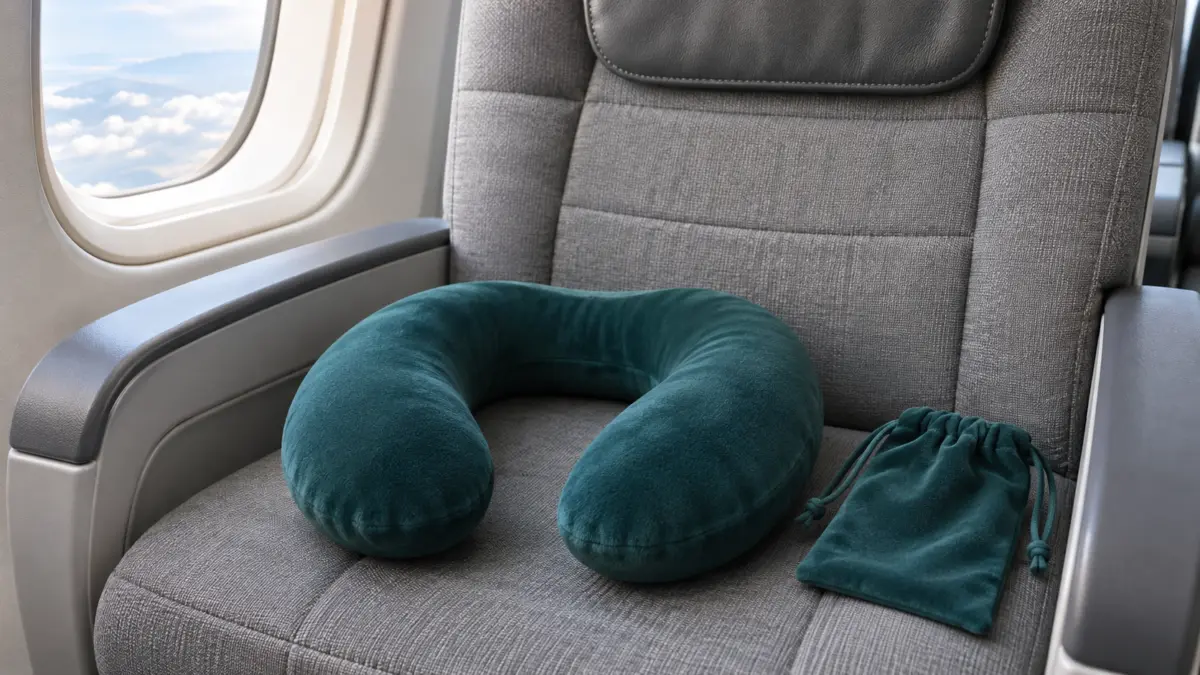
To fit a travel pillow, sit back in the seat first, then position the pillow’s intended support where your head needs it. Adjust its closure, height or air level only as the maker allows. If it pushes your head forward, lifts your jaw or needs an uncomfortable squeeze to stay put, change the setup rather than tightening it further.
The useful question is not simply whether a pillow is U-shaped or made of memory foam. It is whether the seat, the pillow and its adjustment mechanism work together. This guide is for adults resting in an airplane seat; it is not a medical neck-brace fitting guide.
Start with the seat, before adding the pillow
Sit in your usual position with your back supported. Notice what the headrest already does: does it project forward, offer adjustable wings, or leave space beside your head? Put on the jacket, glasses and headphones you expect to use. These become part of the fit, so testing without them can miss a pressure point.
Now add the pillow in its instructed orientation. Compare the position with and without it. You should not need to slide your body forward or shrug your shoulders just to accommodate the padding. If the seat changes during the trip, repeat this check; a comfortable setup in your home chair does not prove it will fit every aircraft seat.
A headrest attachment is a separate feature from a closure around the pillow’s front. Use only the attachment provided for that model, in an allowed configuration, and follow the crew’s instructions. Do not improvise a restraint or route straps across another passenger’s space.
Three mechanisms that adjust different things
The examples below come from manufacturer documentation, not a hands-on comparison or a ranking. They illustrate why one model’s fitting instructions should not be copied onto another.
| Documented example | What changes | What to check in the seat |
|---|---|---|
| Foam U: Cabeau Evolution S3 | Front clasp adjusts the fit; separate straps attach to the headrest area. The pillow has raised sides and a flatter back. | Rear padding against the headrest, side contact, and whether the supplied attachment can be used as instructed. |
| Wrapped support: Trtl Original / Plus | The fabric fastening secures an internal support. Plus also has dials that change support height. | Support position and wrap tension separately; on Plus, assess the height before compensating with a tighter wrap. |
| Inflatable: Aeros Ultralight Traveller, past-season model | A valve changes air level, while an adjustable neck closure changes the opening. | Air level and closure separately. Its narrow center is designed to sit between the neck and headrest. |
See the Evolution S3 specifications, Trtl fitting and care instructions, and Aeros Ultralight Traveller specifications. The Aeros example is explicitly a past-season product; it is not a claim about availability or the dimensions of newer versions.
Do not open a foam travel pillow to remove filling just because it has a zipper. It may only provide access to a washable cover. Our guide to loose-fill and insert adjustments explains those different mechanisms for bed pillows.
A fitting sequence you can repeat
- Identify the support and the controls. Find the exact model’s wearing instructions. Separate a fabric closure, a height adjustment, an air valve and a seat attachment instead of treating them as interchangeable ways to make the pillow tighter.
- Place it before adjusting it. For example, Trtl’s U.S. FAQ places its curved support on the left or right, then wraps and fastens the scarf. That is a model-specific sequence, not permission to turn every travel pillow backward.
- Change one permitted control. Try a small height or air-level adjustment where provided, or reposition the support as directed. Keep the seat position the same so you can tell what changed.
- Check contact while awake and relaxed. Notice whether you reach the support comfortably, whether the back of the pillow crowds the headrest, and whether its edge presses against your jaw or accessories. Stop a setup that feels painful, constricting or interferes with breathing or swallowing.
- Record the useful setting. Note the seat position, support side, height setting or approximate air level, and what felt different. Recheck after a permitted seat adjustment rather than assuming the earlier setting still fits.
A useful note might read: “Upright seat, headphones on; side support reaches my jaw, but the rear padding moves my head forward.” That identifies a rear-clearance problem more clearly than “needs more support.” It also gives the manufacturer something concrete to respond to.
If it still feels wrong, isolate the problem
The back feels crowded. Check the seat’s headrest and the pillow’s rear profile together. Loosening the front may not solve excess padding behind your neck. A different profile may be a better candidate than forcing the same pillow into place.
Your head does not reach the support. Recheck the intended wearing position and any actual height control. A tighter closure changes the fit around you; it does not necessarily make a support taller. Do not use maximum tightness as a substitute for a suitable size.
It works until you put on headphones. Compare with the headphones briefly removed, then worn normally again. If contact changes, you have identified an interaction between the two items. Reposition them within their instructions or consider a different combination; do not accept painful pressure just because each item is comfortable alone.
It slips when you change position. Check the closure and the permitted support position. A design that supports one side may need to be repositioned when you turn. No single setting should be assumed to cover every resting position.
Cleaning and packing are also model-specific
For the Evolution S3, Cabeau permits cool machine washing of the removed fabric cover and low tumble drying. Its foam insert should be wiped with a damp cloth and air-dried, not washed. This is the same distinction explained in our solid memory foam cover-versus-core care guide.
Trtl’s aftercare page says to remove the Original’s plastic support before a 30°C/cool wash of the fabric. For Plus, it describes removing the support from the scarf and drip-drying the washed fabric. Follow the instructions for the version you own.
The Aeros Ultralight Traveller page specifies hand washing with the valve closed and air drying, with no washer or dryer. Sea to Summit’s Aeros care guide also distinguishes compact travel packing from long-term storage: once dry, store it flat or loosely rolled with the valve open. A small stuff sack is not automatically the right place to leave it between trips.
Questions before your next flight
Should the opening of a U-shaped pillow face forward or backward?
Follow that model’s instructions. A closure, shaped rear section or seat attachment can make orientation matter. A social-media demonstration with a different pillow does not establish that yours should be reversed.
Does an adjustable closure mean adjustable height?
No. Look for a specific height mechanism. A wrap or clasp can change how the pillow sits around you without changing the height of its internal support. On an inflatable, changing the air also changes how the pillow yields, so assess the result rather than assigning a universal number of breaths.
Can I use the same fit check for my bed pillow?
A bed pillow works with your mattress and a lying position, so start a separate assessment. Our bed-pillow height guide covers that situation. A travel pillow that feels comfortable upright is not evidence that it fits when lying down.
Does the pillow make it safe to sleep without my seat belt?
No. It is a comfort accessory. The FAA advises wearing a seat belt whenever seated and paying attention to the safety briefing. Keep the pillow out of the belt’s operation and follow instructions from the crew.
How to use this comparison
Choose a setup you can describe and repeat, then decide whether it remains comfortable in the actual seat. The aim is to identify what works with your surroundings, not to force a particular product to fit.
A 2018 study on expected and experienced neck comfort reported that judging travel pillows from pictures did not reliably predict the comfort experienced. We consulted its published abstract, not the full study; it does not establish a best current product or a medical benefit for an individual traveler.
Manufacturer documentation checked November 4, 2026. The fitting sequence and observation examples are BestPillows editorial aids, not validated clinical tests. No physical product tests were performed, and the named products are examples rather than purchase recommendations.