

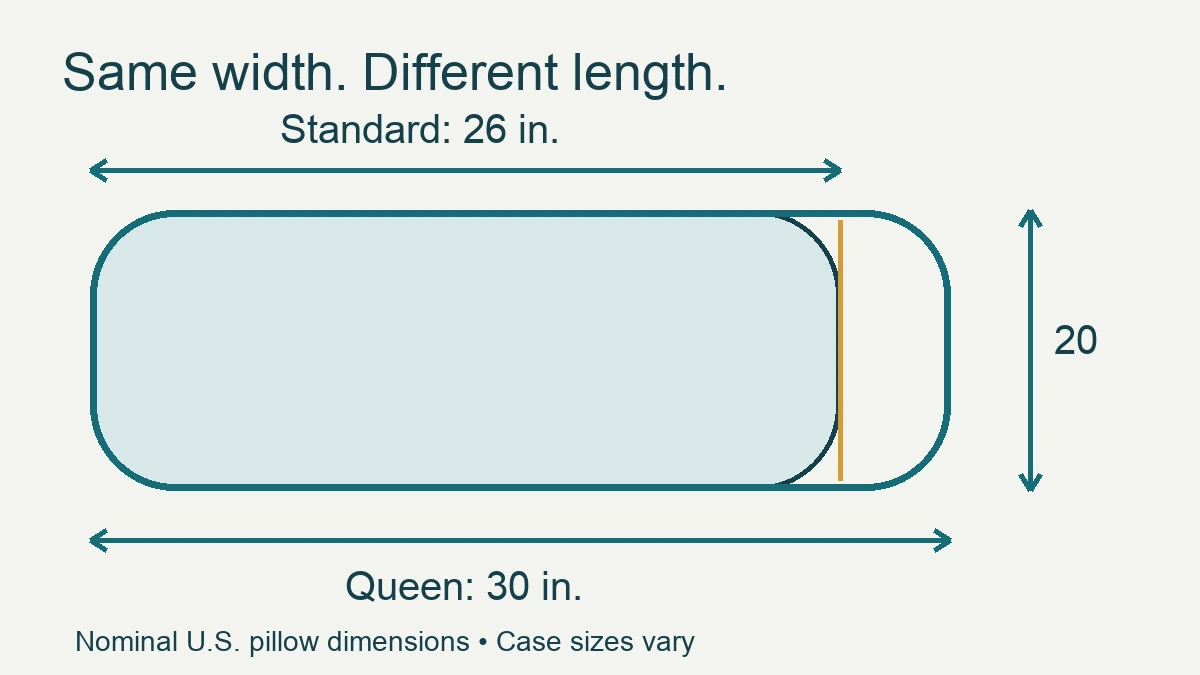
A queen pillow may fit a pillowcase sold as standard, but the name alone cannot tell you whether the pillow will be fully covered without being squeezed. Check the case’s actual dimensions and closure before buying a replacement.
In common U.S. sizing, a standard pillow is 20 × 26 inches and a queen is 20 × 30 inches. Those are pillow sizes—not a guarantee about the space inside every case labeled “standard.” Purple’s size guide gives those pillow dimensions and also lists its own standard cases at 20 × 30 inches.
“Standard” does not mean the same case everywhere
Here are three examples from brand documentation. The measurements describe listings and size guides; BestPillows has not physically tested these combinations.
| Brand and source | Listed case size | What it tells you |
|---|---|---|
| Purple pillowcase guide | Standard: 20 × 30 in. | The standard label can include a case as long as a nominal queen pillow. Confirm the specific product and closure. |
| Piglet in Bed U.S. guide | Standard: 20 × 26 in.; queen: 20 × 29 in. | Even the queen label is not a universal 30-inch specification. Use the current product’s fit guidance. |
| The Company Store, Company Cotton Classic Smooth Sateen Solid Pillowcase Set | Standard: 20 × 30 in. | A public brand reply on September 16, 2026 says it is designed for a 20 × 26-inch standard pillow with a 4-inch hem. The listed 30 inches do not establish a queen fit. |
The Company Store example is a reason to read beyond the dimension line. A hem at an open end is not necessarily a separate, unusable compartment, so you should not automatically subtract it and declare the case too short either. The important question is whether the maker intends the pillow to remain covered at the opening. A nominal match of 20 × 30 to 20 × 30 is not proof.
Check the case you already own
Start with the pillow’s label. If it has no size label, measure its length and width between seams with a soft tape, without stretching the fabric or flattening the fill hard. Record the actual measurements rather than assuming that a pillow from a queen bedding set is queen size.
Next, lay the empty, dry pillowcase flat. Measure across the main body, excluding a decorative border. Measure length from the closed-end seam to the opening. For an envelope case, identify the pocket where the pillow end is supposed to tuck in. For a zippered case, measure the usable body up to the zipper. These checks distinguish the space available to the pillow from fabric that extends beyond it.
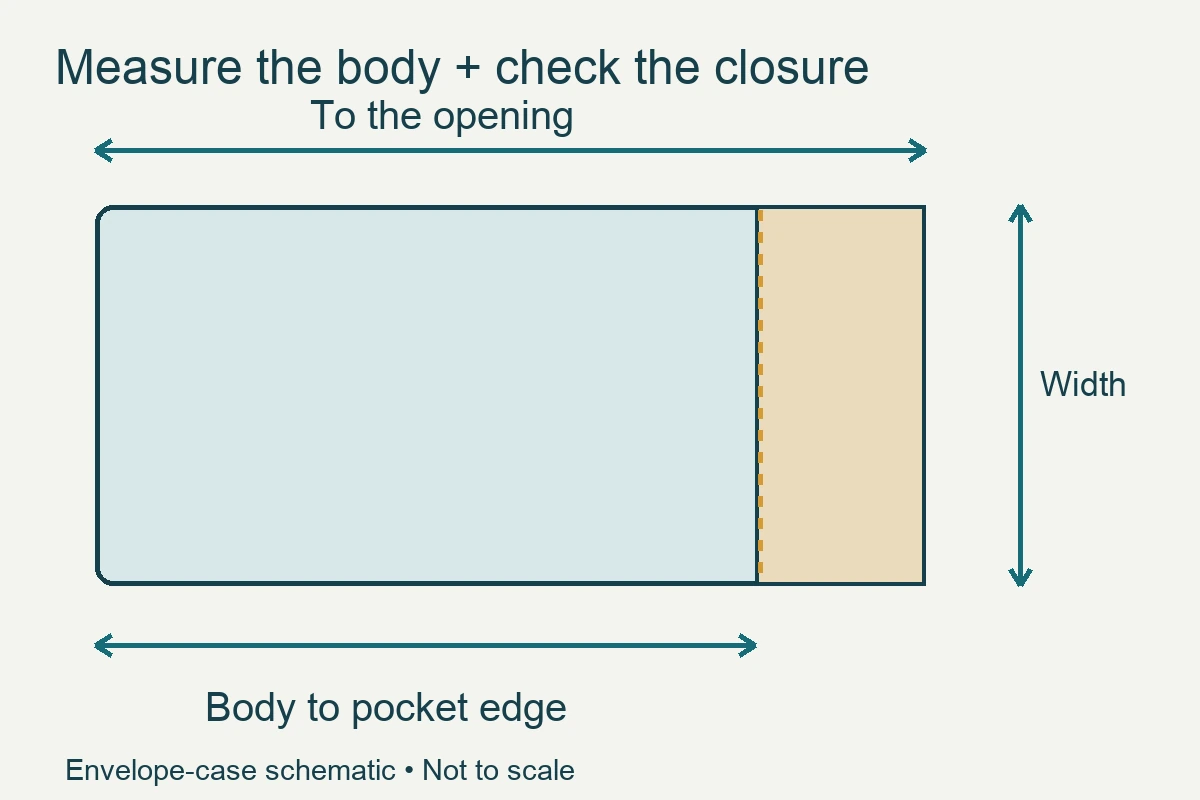
A flat measurement is a useful first check, not a three-dimensional fit test. A thick pillow takes up space as the case wraps around it. An added protector takes up room too. Fabric stretch and the closure can change the result, even when two cases list the same dimensions.
Try it without forcing the closure
Insert the pillow, settle the corners, and smooth the case. With an envelope closure, the end should stay tucked inside the pocket. A zipper should close without pulling the pillow into a compressed shape. In an open-end case, check that the pillow is covered rather than exposed at the mouth.
Then look at the pillow itself. If the case bows tightly, flattens the edges, pulls the corners together, or stops the pillow from taking its usual shape, the combination is too restrictive for that pillow. A case that slides on is not necessarily a comfortable fit. Do not remove fill from an adjustable pillow solely to accommodate a case that is too small.
If you already own another, roomier case, compare the pillow’s shape in both. That is a practical fit check you can make at home; it does not establish that either case will work for a different pillow.
What to look for when buying another case
Choose a case whose current product documentation explicitly accommodates your pillow’s actual size. A “standard/queen” label is useful only when the dimensions and fit guidance support it. If the listing gives overall dimensions but leaves the hem, envelope pocket, or intended pillow size unclear, ask the seller before ordering.
For a contoured pillow, check the pillow maker’s case recommendation as well. A rectangular size chart may miss the extra room needed around raised edges. For an ordinary queen pillow, your decision is simpler: keep the standard case if it covers the pillow and lets it hold its shape; replace it if the opening exposes the end or the fabric squeezes the fill.
Documentation checked October 1, 2026. Dimensions and product versions can change; the current product listing and your own fit check take priority.