

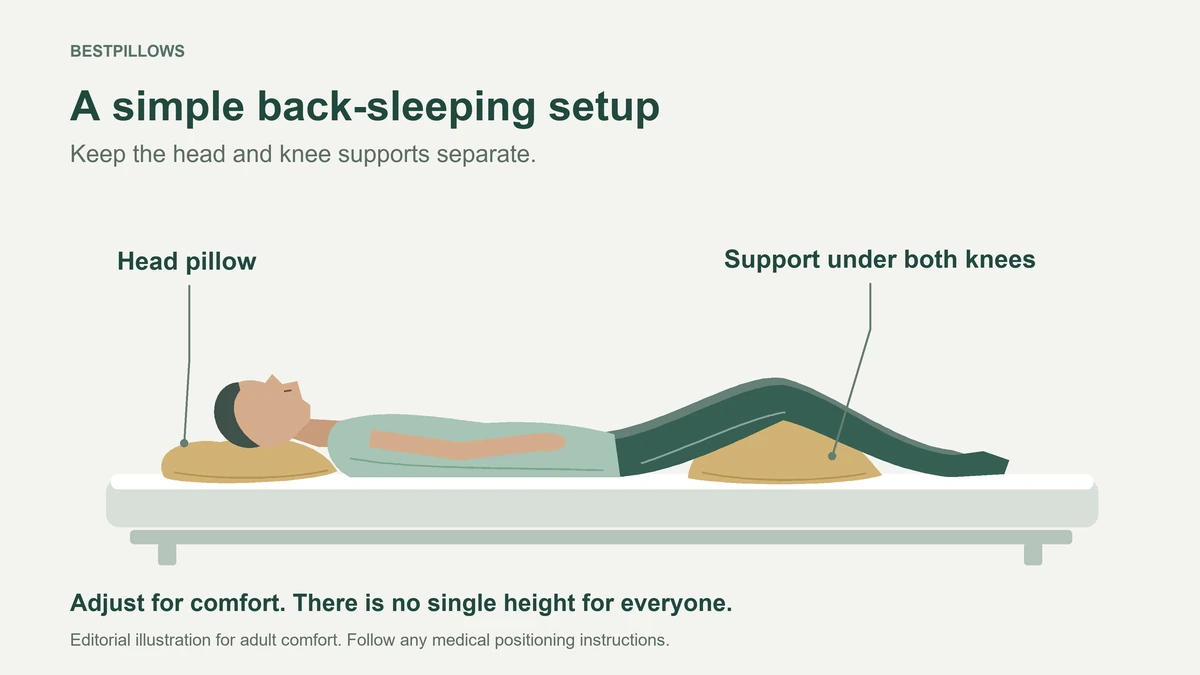
If you already sleep on your back, a spare pillow placed crosswise beneath both knees is a simple setup to try. Let your legs rest on it with a comfortable bend, and keep a separate pillow under your head. You do not need to buy a specialty knee pillow to explore whether the extra support feels useful.
Mayo Clinic’s sleeping-position guidance says this arrangement may help relax the back muscles and maintain the lower back’s curve. MedlinePlus also suggests a rolled towel as an option. Neither guide specifies one pillow height in inches for everyone.
This guide covers general adult comfort. If you have been given positioning instructions after surgery or for a medical condition, follow those instructions before trying a different setup.
Place the support under both knees
Use your usual mattress, bedding, and head pillow so you can notice what the additional support changes. Place an ordinary pillow across the bed beneath both knees. If you choose a rolled towel, make it wide enough to reach both knees without having to squeeze your legs together.
Let your legs settle onto the support. Check whether it stays where you put it and whether a seam, firm edge, or uneven patch of filling feels uncomfortable. Move or reshape it before adding more height. A pillow positioned only beneath your feet is a different arrangement from the under-knee setup described here.
Your head pillow still has its own job. Changing the support under your legs does not tell you whether your neck pillow fits. If you use a shaped model and are unsure which edge faces your shoulders, see our contour pillow orientation guide.
Judge height with your legs resting on it
A product’s listed thickness describes its dimensions, but it does not show exactly how the pillow will feel beneath your legs. Compare the setup while lying on your own bed, with the pillow inside the cover you intend to use.
Start with a modest amount of padding that lets your knees bend comfortably. While awake, make these observations:
- Does the bend feel comfortable? If your legs feel pushed into more of a bend than you want, compare a thinner support or remove it.
- Can you relax your legs? If you keep lifting them or holding them together to stop the pillow moving, reposition it or try a different width.
- Does the contact feel even? Smooth a lumpy pillow or loosen a hard towel roll. More height will not necessarily resolve an uncomfortable surface.
- Can you change position easily? Try turning and moving the pillow aside. Keep enough room to do that without wrestling with the bedding.
These are editorial comfort checks, not a way to measure spinal alignment. If you compare two arrangements, change one feature at a time: placement first, then thickness. You do not need to reach a particular knee angle or make your lower back look a certain way.
If your pillow has removable filling, adjust it only as its manufacturer permits. Save what you remove so you can reverse the change. Our guide to loose fill and removable inserts explains the difference between an adjustment opening and a zipper that only removes the cover.
Compare a spare pillow, towel roll, or shaped support
Start with what you have. An ordinary pillow lets you compare different positions without choosing a new product. A towel roll gives you another way to explore the amount of padding: unroll and reshape it if the first arrangement feels too bulky or firm.
If you later consider a bolster or wedge, check its intended use, dimensions, cover, and return conditions. A shaped support offers fewer ways to alter its profile than a pillow with adjustable fill. Look at whether the whole shape suits the space under your legs, rather than choosing by maximum height alone.
A small pillow designed to sit between the knees during side sleeping may have a shape that is awkward beneath both knees. Check the manufacturer’s positioning directions before using the same product for a different purpose. A label such as “orthopedic” does not replace that fit check.
Reposition the pillow if you turn onto your side
Do not wedge yourself into place simply to keep the pillow beneath your knees. If you prefer to turn, allow room to move it. The position you find comfortable on your back may be inconvenient once you are on your side.
For readers who want support while side sleeping, our body pillow placement guide covers a separate arrangement for the upper arm and legs. Choose the setup that suits the position you actually use.
When this general setup does not apply
After knee replacement: do not adopt this arrangement as a recovery tip. MedlinePlus discharge guidance specifically advises keeping the knee straight and avoiding a pillow beneath it. Your surgical team’s instructions take priority.
With sleep apnea: follow your treatment and positioning plan. The NHLBI notes that a clinician may recommend side sleeping. A pillow beneath the knees does not replace that advice.
During pregnancy: this is not a recommendation to switch to back sleeping. ACOG discusses side sleeping in the second and third trimesters; ask your maternity team about your own needs.
If the arrangement causes pain, tingling, or numbness, stop using it. Persistent or worsening symptoms need professional assessment rather than repeated pillow adjustments.
Sources checked October 7, 2026. BestPillows developed the practical fit checks as editorial guidance. They are not a clinical assessment, and we have not physically tested or ranked knee pillows for this article.