

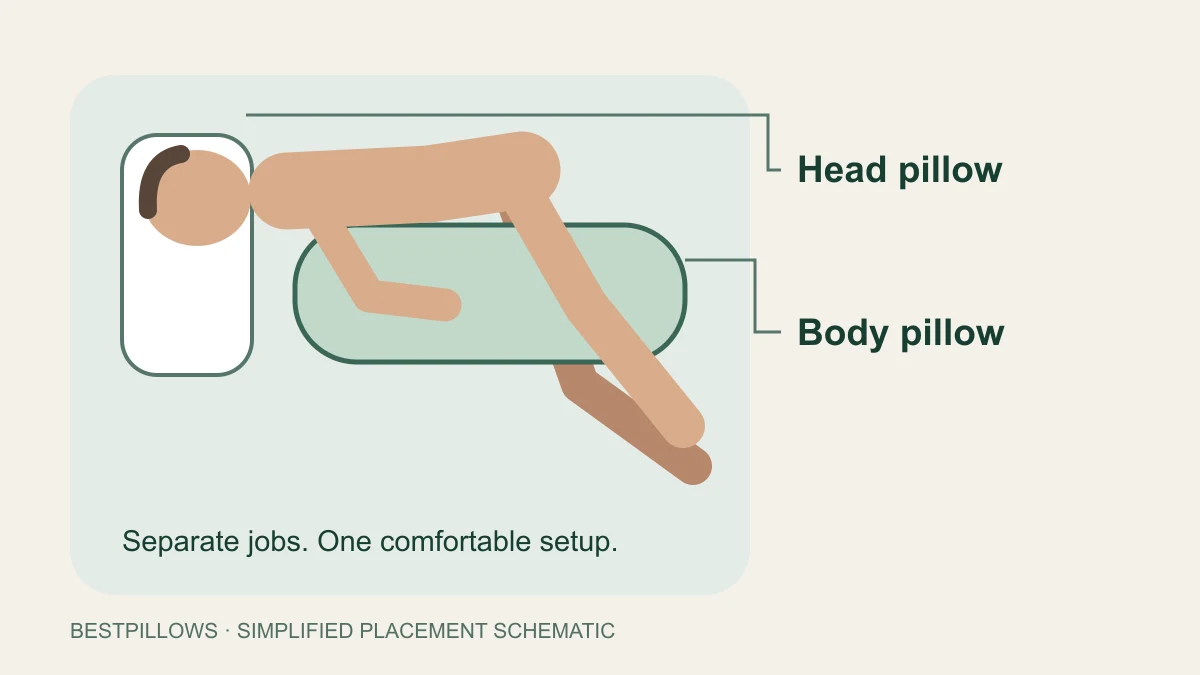
To use a straight body pillow for side sleeping, place it lengthwise in front of you, rest your upper arm around it, and position the lower section between your comfortably bent knees. If it reaches your ankles without making you curl up to meet it, you can support that area too. Keep a separate pillow under your head.
That starting position follows Naturepedic’s body-pillow guidance. The next step is checking whether the pillow actually fits you. A long pillow can still be too bulky to hug, too short for the support you want, or awkward to move in a shared bed.
Set up your head pillow first
Start with the head pillow you normally use for side sleeping. The body pillow has a different job: giving your arm and legs somewhere to rest. Don’t stack its upper end on top of your head pillow just to use its entire length.
This guide covers a straight, adult body pillow. A U-, C-, or J-shaped product may include a section intended for the head; follow that model’s directions rather than forcing it into the arrangement shown here. Bearaby’s placement guide illustrates why the shape changes the setup.
If your separate head pillow has a contour and you are unsure which edge belongs under your neck, check our guide to contour pillow orientation before adding another pillow to the bed.
Place it, then check three contact points
Lie on your usual side and bring the body pillow toward you. Let your knees bend comfortably. Rest your upper arm on the upper section and place the lower section between your knees. You should not have to squeeze the pillow tightly or hold an exaggerated curled position to keep contact.
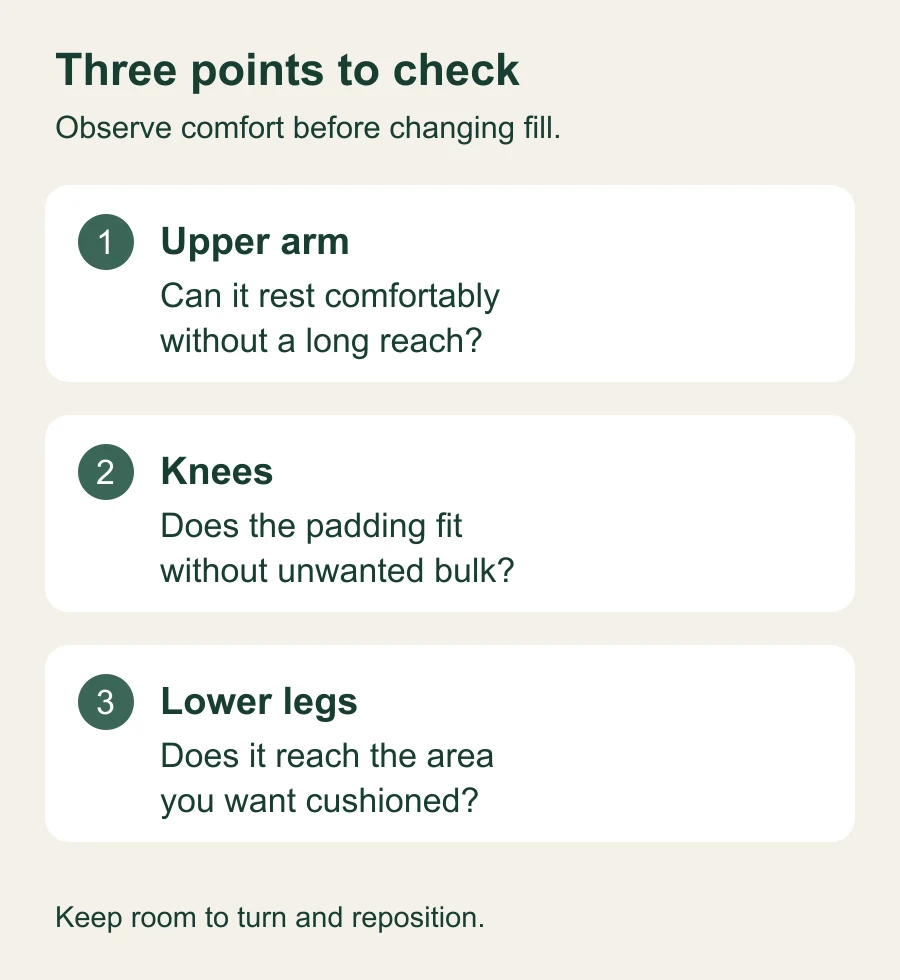
Now make three observations:
- Upper arm: can you rest it without reaching far forward or lifting your shoulder toward your ear? Move the pillow closer or slightly lower and compare.
- Knees: does the padding feel comfortable between them, or does its bulk push them farther apart than you want? Try repositioning before changing the fill.
- Lower legs: if you want cushioning down to the ankles, does the pillow reach naturally? Don’t pull your feet upward simply to match the pillow’s length.
These are comfort checks, not a test of spinal alignment or a treatment for pain. There is no single distance between the knees or fixed pillow thickness that this guide can prescribe for every adult.
Length on the label is only part of the fit
Measure the pillow itself and compare that with the space it occupies in your actual sleeping position. A measurement from the top of your head to your feet is not especially useful when your head has its own pillow and your legs are bent.
For a concrete size reference, Coop’s Original Adjustable Body Pillow is listed at 20 × 54 inches. The company also identifies its memory-foam-and-microfiber fill and allows fill adjustment. Those are specifications for that model, not a universal body-pillow size or a guarantee that it will fit your height.
Before buying, lay a tape measure on the bed to visualize the listed length and width, then remove it before lying down. Remember that a flat outline cannot reproduce the pillow’s thickness or how far it compresses. Check the return policy if you cannot assess those features in person.
Check the cover as part of the setup
Use a cover intended for the body pillow’s dimensions and shape. If closing it noticeably changes the pillow’s shape, check compatibility rather than removing fill just to force the closure.
A standard or queen head-pillow case is not a substitute for a correctly sized body-pillow cover. If you want an additional protective layer, our guide to choosing a pillow protector explains how to distinguish protection, closure, and fit; confirm that the particular product comes in your body-pillow size.
When the setup feels wrong
It feels too thick to hug
Try moving it a little farther down the bed or changing where your arm rests. If the bulk still makes you reach or lift your arm awkwardly, the shape or thickness may not suit you.
Only remove filling if the manufacturer provides an adjustment opening and permits it. Start with a small amount, save it, close the pillow, and reassess. Our pillow adjustment guide covers loose fill and removable inserts. A zipper on an outer cover does not establish that the inner pillow is adjustable.
It reaches your arms or your knees, but not both
Decide which area actually needs the extra cushion. Moving the pillow downward may work if you mainly want it between your legs. If you want both contact points, compare a longer pillow with using separate smaller pillows. You do not need to make one product perform every support task.
It gets in the way when you turn over
While awake, try turning to your other side with your normal bedding in place. Check whether you can reposition the pillow comfortably and still have room beside you. If the movement is cumbersome, try a smaller arrangement. Don’t wedge yourself tightly between pillows to keep a particular position. If you also rest on your back, our guide to placing a pillow under both knees explains that separate setup.
A body pillow or two ordinary pillows?
Before purchasing, you can try one spare pillow for your upper arm and another between your knees. This is a way to discover which contact points you prefer, not an exact simulation of a body pillow’s feel.
A single long pillow may suit you if you want those contact points connected and enjoy hugging something substantial. Separate pillows let you adjust the arm and leg sections independently. Compare how each arrangement moves with you and how much bed space it uses; neither format is automatically the better choice.
For tonight’s check, use your usual bedding and change one part of the arrangement at a time. Keep the configuration that feels comfortable and easy to leave. If positioning causes pain or numbness, stop; persistent symptoms, an injury, or postoperative restrictions call for individual professional advice.
Sources checked October 4, 2026. The fit checks and illustrations are BestPillows editorial tools. We have not physically tested the products mentioned. This guide addresses adult comfort and product setup.